Same pain, two very different prescriptions
Anyone who has used an LLM for serious work — reading contracts, analyzing financial reports, synthesizing research — knows the lingering anxiety: the AI can fabricate. RAG (Retrieval-Augmented Generation) was invented to reduce that anxiety. But RAG and NKTg AI – LLM actually solve the problem at two different layers, using opposite philosophies. This article breaks down the fundamentals, so you can decide which fits your use case — or use both.
1. The algorithmic core: measuring “similarity” vs measuring “importance”
Traditional RAG — Vector Search & Embeddings:
- Built on statistical probability and spatial similarity (cosine similarity)
- The mechanics: split documents into chunks → embed as vectors → find passages “close in meaning” to the query → dump them into the context window for the LLM to read
- The core limitation: similarity only tells you “which passage resembles the question” — not which passage actually matters in the document’s logic. A sentence carrying the binding action and a sentence of boilerplate conditions can score as “similar.”
NKTg AI — the NKTg Law:
- Built on a physics-inspired algorithm, the inertia-variation operator (NKTg Law):
textCopy
NKTg  = f(x, v, m)
p     = m × v
NKTg₁ = x × p          (Potential semantic energy)
NKTg₂ = (dm/dt) × p (Kinetic semantic energy)- It measures the semantic energy of every sentence: AMP (amplifying: actions, assertions, results) / DAMP (damping: conditions, exceptions, risks) / STABLE (pure data). Always obeying AMP% + DAMP% + STABLE% = 100%
- When AMP > 55%, the text has a clear focal point and the Core Content — the verbatim sentence with the highest density of executable actions and the most concrete outcome — can be reliably extracted
In short: RAG answers “which passage resembles the question?”. NKTg AI answers “what does this text actually assert, under which conditions?”.
2. The intermediate layer: “gathering papers” vs “scanning the DNA”
RAG has no dedicated decoding brain. It picks (Retrieve) raw passages and throws (Augment) them directly at the LLM. Everything — deciding what is an action vs a condition, an assertion vs a risk — is left to the LLM’s own reasoning in a single forward pass.
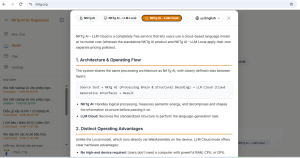
NKTg AI – LLM makes NKTg AI a standalone logic & quantification processing brain sitting before the LLM:
textCopy
Raw text → [NKTg AI: decode structure, normalize, extract Core Content]
        → [Verified analysis result]
        → [LLM: only generates language from that logical frame]
The LLM (Local or Cloud) never sees the raw text and never reasons over raw data — it is purely a Generative Interface, converting an existing logical frame into fluent natural language.
To be fair: modern RAG has evolved — re-ranking, structured retrieval, GraphRAG. But the fundamental difference stands: the intermediate layer of RAG outputs a relevance-ranked list of raw chunks; NKTg AI outputs a verified analysis that preserves the original sentences.
3. Hallucination control: reducing probability vs blocking architecturally
RAG reduces hallucination probabilistically — better chunks in, less fabrication out. But the risk persists: retrieved chunks arrive noisy and long, or the LLM “embellishes” while synthesizing across the context window.
NKTg AI – LLM controls hallucination at the architecture level, with a two-layer filter:
- NKTg AI completely isolates risky/noise components (DAMP) from the core action sentence, returning data in its original form, untouched by subjective interpretation
- The LLM only receives this verified data — garbage that can’t enter the input cannot appear in the output
An honest caveat: system-wide fidelity is bounded by the accuracy of the decoding layer, not some magical “100%.” But that’s precisely the strength — when errors occur, they live in a measurable, debuggable scoring layer, not in the opaque “misunderstanding” of a probabilistic model.
4. Side-by-side comparison
| Criterion | Traditional RAG | NKTg AI – LLM |
|---|---|---|
| Processing basis | Vector representation & probabilistic similarity | Semantic energy & physics operators (NKTg Law) |
| Question it answers | “Which passage resembles the query?” | “What does this text assert, under what conditions?” |
| Context handling | Dumps retrieved chunks into the LLM | Splits AMP (action) vs DAMP (conditions/risks), extracts Core Content |
| LLM’s role | Reads, analyzes, reasons, and writes the answer | Purely a generative interface over an existing logical frame |
| Fidelity to source | LLM may reinterpret, shifting the author’s intent | The language “DNA” is preserved — the core sentence stays verbatim |
| Hallucination control | Probabilistic reduction (depends on retrieval quality) | Architectural block (the LLM has no raw data to fabricate from) |
| Unit of processing | Chunks (machine-split) | Verbatim sentences |
| Execution | Usually needs a Vector DB + cloud LLM | LLM Local runs 100% in the browser (WebAssembly) — text never leaves the device |
| Scope | Large knowledge bases, many documents | One document requiring absolute fidelity |
5. The analogy to remember
- RAG is like handing a librarian a stack of loosely relevant papers and asking them to read and summarize — a good librarian does well, but they can still misread or overstate.
- NKTg AI – LLM is like running a dedicated scanner that extracts the document’s core DNA first, then handing it to the scribe — whose only job is now to write it up, not to understand it.
6. So which one should you use?
This is not an “A replaces B” story. The two architectures solve different problems and stack cleanly:
- Need Q&A over a large knowledge base (thousands of documents, knowledge beyond any single text) → RAG is the right tool
- Need absolute fidelity to one specific document (contracts, audit reports, legal/research material) → NKTg AI – LLM was built for this
- And the near-future composition: NKTg AI’s decoding layer can sit in front of a RAG pipeline — doing structural analysis instead of blind chunking.
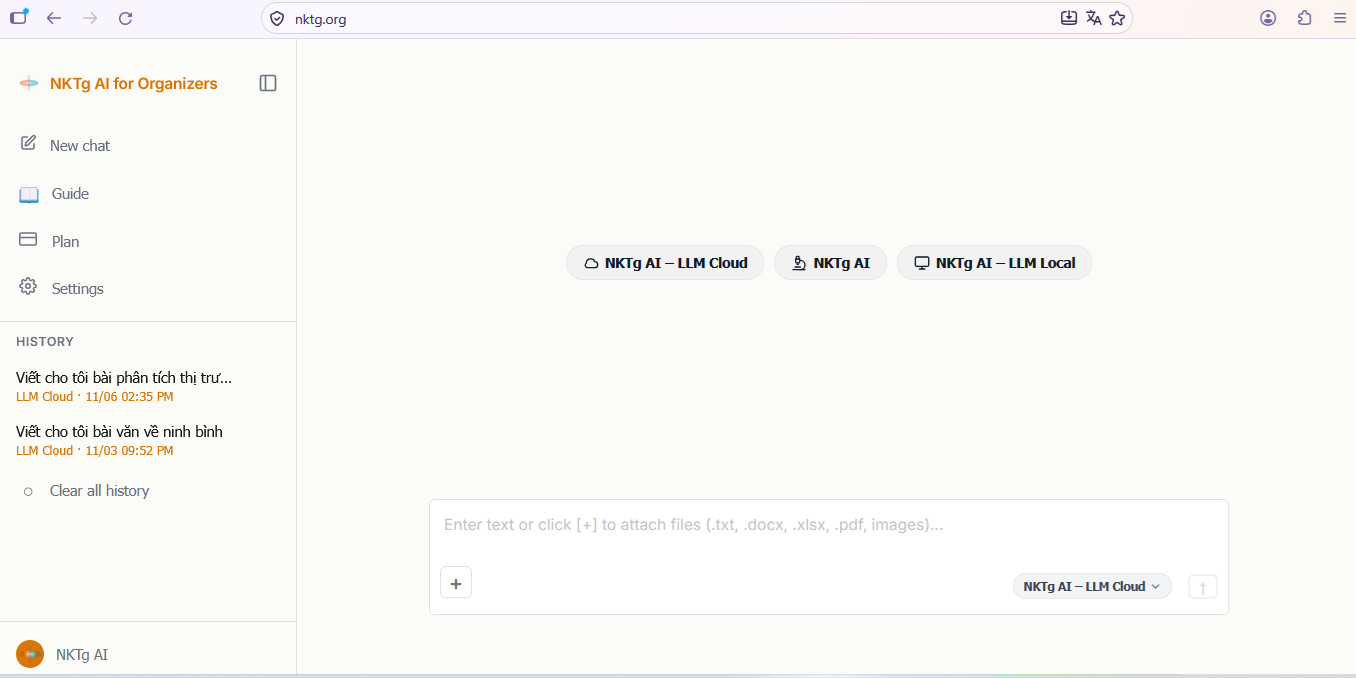
Try it yourself at nktg.org — paste a contract or a long report, check the AMP/DAMP% and Core Content before deciding whether the full document deserves a careful read. LLM Cloud mode is free; in LLM Local mode your text never leaves your device.