NKTg AI: Beyond RAG — A New Approach to Semantic Intelligence
NKTg AI for Organizers | NKTg
Traditional RAG helps AI retrieve relevant information. NKTg AI takes a different approach: analyzing semantic structures, identifying core propositions, distinguishing actions from conditions, and preserving original statements before information reaches the Large Language Model (LLM).
The difference is fundamental: RAG focuses on finding relevant information. NKTg AI focuses on understanding what the information actually asserts.
1. Two Different Approaches to Information Processing
RAG — Retrieval-Augmented Generation
RAG typically uses Embeddings and Vector Search to retrieve document segments based on semantic similarity.
Its workflow:
Document → Chunking → Embedding → Vector Search → Retrieved Context → LLM → Response.
This approach is effective for searching large knowledge repositories. However, semantic similarity does not necessarily reflect logical importance.
For example, a contractual obligation and the condition governing that obligation may both be relevant to payment, but they serve different semantic functions.
NKTg AI — Semantic Structure Analysis
NKTg AI introduces a different processing framework based on NKTg Law and the Variable Inertia Operator.
Its conceptual model:
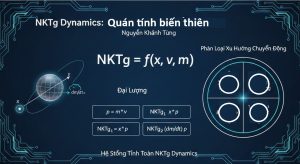
NKTg = f(x, v, m)
p = m × v
NKTg₁ = x × p (Semantic Potential Energy)
NKTg₂ = (dm/dt) × p (Semantic Kinetic Energy)
The system organizes information into three categories:
- AMP (Action – Meaning – Proposition): Actions, assertions, and concrete outcomes.
- DAMP (Dynamic/Dependent Meaning): Conditions, dependencies, exceptions, and risks.
- STABLE: Stable information and factual data.
AMP% + DAMP% + STABLE% = 100%.
When AMP exceeds the defined 55% threshold, NKTg AI identifies an action-dominant document and applies its Core Content extraction mechanism.
Core Content identifies original sentences with high action density and concrete semantic significance according to the system’s criteria.
2. A Different Architecture for LLM Processing
Traditional RAG retrieves information and relies on the LLM to perform subsequent interpretation and reasoning.
NKTg AI introduces a dedicated semantic processing layer before generation.
NKTg AI Architecture:
Source Document → Semantic Analysis → AMP/DAMP/STABLE Classification → Core Content → Structured Information → LLM → Response.
NKTg AI handles semantic analysis and information organization. The LLM handles language generation, summarization, and response presentation.
This separation is designed to reduce irrelevant information, preserve source statements, and improve control over the information supplied to the LLM.
3. A Different Approach to AI Hallucination
RAG reduces hallucination risks by grounding LLM responses in retrieved information.
However, missing conditions, fragmented context, irrelevant passages, and incorrect synthesis can still affect the final output.
NKTg AI approaches the problem at the information-processing layer.
By identifying actions, conditions, exceptions, and original statements before generation, the system aims to make the information provided to the LLM more structured and traceable.
No architecture can guarantee the complete elimination of AI hallucinations. NKTg AI instead focuses on making semantic processing more explicit, inspectable, and controllable.
4. Different Technologies for Different Problems
| RAG | NKTg AI |
|---|---|
| Information retrieval | Semantic structure analysis |
| Embeddings and Vector Search | NKTg Law |
| Document chunks | Sentences and semantic structures |
| Relevance ranking | Semantic classification |
| Retrieves relevant passages | Identifies core propositions |
| Relies on LLM interpretation | Processes information before generation |
| Large-scale knowledge retrieval | In-depth document analysis |
RAG is particularly suitable for enterprise knowledge bases, multi-document search, and information discovery.
NKTg AI is designed for applications requiring structured document analysis, including contracts, financial reports, scientific research, obligations, conditions, and exceptions.
5. Beyond Competition: An Opportunity for Integration
RAG and NKTg AI do not necessarily need to operate independently.
A combined architecture could use RAG to retrieve relevant documents and NKTg AI to analyze their semantic structures before passing the processed information to an LLM.
Retrieval → NKTg Semantic Analysis → AMP/DAMP/STABLE → Core Content → LLM → Response.
This approach combines large-scale information discovery with specialized semantic processing.
Conclusion: Moving Toward Structured Semantic Intelligence
The next stage of AI development is not simply about retrieving more information. It is also about improving how information is analyzed, organized, preserved, and verified before generation.
RAG provides a foundation for connecting LLMs with external knowledge.
NKTg AI explores a complementary direction: introducing a dedicated semantic intelligence layer between source information and generative AI.
NKTg AI — Semantic Intelligence. Structured Understanding. More Controlled AI Generation.
Website: https://nktg.org/